
Why Do Japanese People Work So Hard? A Look Beyond Stereotypes
INDEX
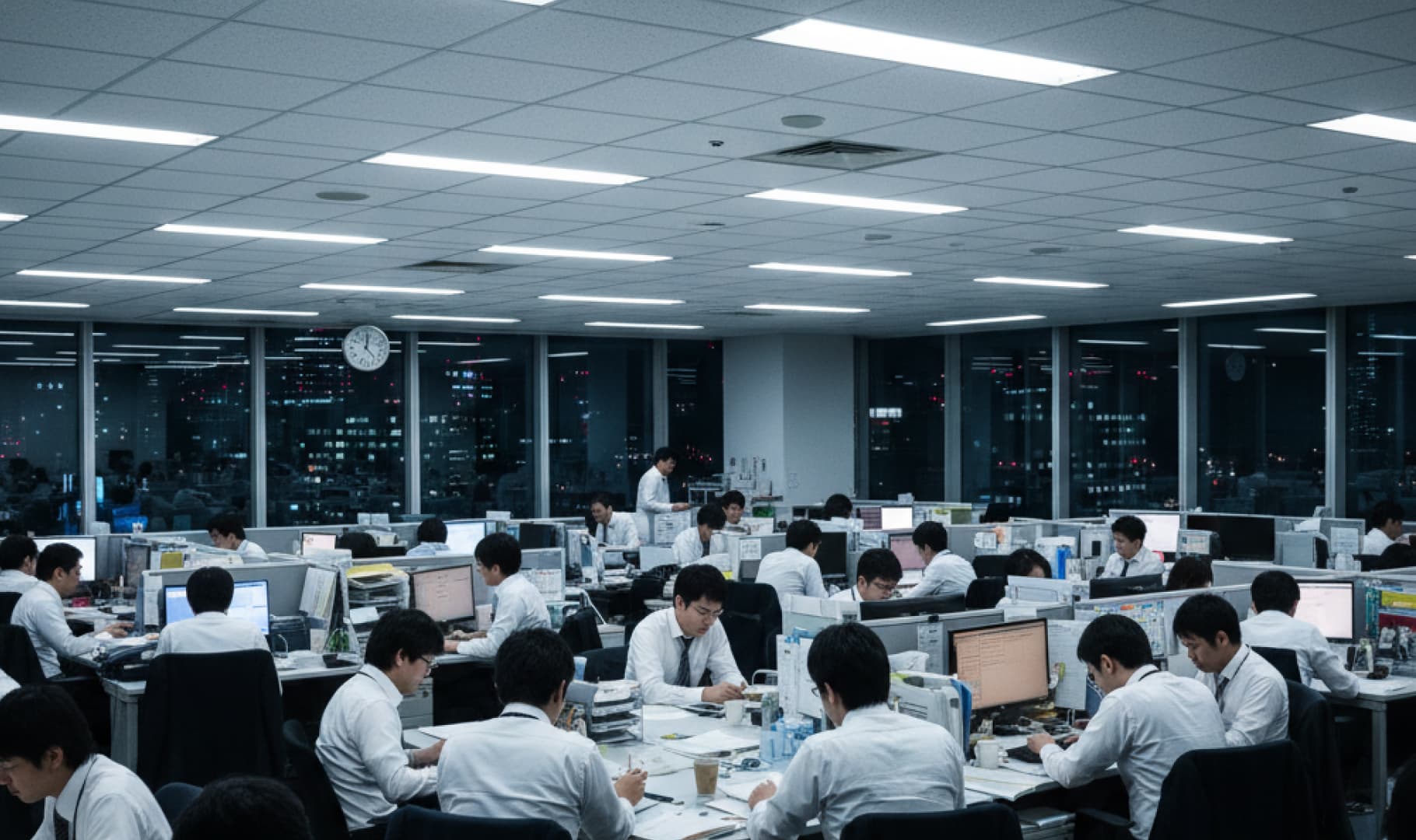
Have you ever wondered about the seemingly strange and mysterious behaviors of Japanese people? In this article, I want to explore one of the most common questions from a Japanese perspective: "Why do Japanese people work so hard?"
Let me start with a personal story. In my 20s, I lived in a share house with several people from other countries. On weekdays, I was buried in work, usually not getting back home until around 10 p.m. It was only on Friday and Saturday nights that I finally felt free, and I’d spend those nights drinking and talking with my housemates. I had a great time, but I was in a constant state of exhaustion.
Despite this, I was proud of myself for working long hours, sacrificing my personal time, and dedicating myself to my job. I believed that the harder I worked, the more my personal value increased, and that I was growing as an adult, one step at a time.
Then one day, a French friend who lived with me asked a simple question.
"Why do you work so late? Don't you have a family or friends who are important to you?"
I was taken aback. "Wait a minute," I thought. "Are you criticizing me for working this hard? For doing valuable work?" But he continued.
"By spending all your time working, you are neglecting the most important people in your life: your family and friends."
For someone from another culture, his words might have sounded perfectly reasonable. But for me, a Japanese person who had been taught that work was the most important thing in life, it was a profound shock. At the same time, it made me wonder for the first time:
"Why am I working this desperately every day?"
That’s the thing. Unless someone points it out, it doesn't even register as strange. For many Japanese people, working diligently from morning to night is the greatest virtue—a truth that seems beyond question.
So, let's unravel this great mystery together. Why do Japanese people work so hard?
The Three Real Reasons Japanese People Work So Hard
Common explanations often point to Japan's history as an agrarian society, where the need to tend to crops daily fostered a diligent nature. Others suggest that the spirit of the samurai—with its emphasis on loyalty to one's master and self-discipline—has carried over into the modern work ethic.
But are those the only reasons?
Obviously, the vast majority of modern Japanese are not samurai, and very few work in agriculture. It’s a stretch to attribute today’s work culture solely to these ancient historical and ethnic traits.
I believe the real reasons Japanese people work so hard today can be boiled down to these three points:
- The process of work is seen as sacred.
- The people you work with don’t change.
- The country has a historical lack of resources.
1. The Sanctification of the Work Process
In Japan, there is a tendency to sanctify and value the fact that you are working and the process of that work, often more than the actual numerical results or outcomes.
To put it more concretely, there's a belief that the time spent working itself helps you grow and become a more refined human being. This is valued more highly than the amount of money you earn or the specific value you create for someone else.
This concept is reflected in the Japanese language. Words like "Judo" (柔道), "Sado" (茶道, tea ceremony), and "Bushido" (武士道, the way of the warrior) all share the character "道" (dō), which means "the way" or "the path." This "dō" implies not just mastering a skill, but also cultivating one's spirit through the pursuit of that path.
From a young age, Japanese people are taught to polish their character through such activities. For example, most students participate in bukatsu, or school club activities, where they engage in sports, music, or cultural pursuits as a group. In bukatsu, the emphasis is not just on improving one's technical skill, but on forging one's spirit as well.
This educational philosophy becomes deeply ingrained and carries over into the professional world. Work is not just a means to acquire skills; it is a path to developing one's character.
This sanctification of work is so deeply rooted that it can sometimes lead people to prioritize their jobs to the point of neglecting their families—just as I did in my 20s. Conversely, because the act of working is itself the prize, there's a tendency to dislike or avoid receiving what might be seen as excessive compensation for the results of that work.
However, evaluating the process of work is difficult. You can quantify results, but how do you measure the effort put into the process?
The answer is simple: the easiest way to quantify the work process is by measuring the length of time worked.
As a result, the idea of working long hours became intertwined with the virtue of working hard. The belief that the length of the process could be measured by time—and that this time would directly contribute to the company's success—is a major reason why Japanese people have worked so hard for so long.
2. Because Your Colleagues Don't Change
Historically, the Japanese corporate system has been defined by two major features:
- Nenkō joretsu (Seniority-based promotion): Those who have been with the company longer are valued more and promoted.
- Shūshin koyō (Lifetime employment): Companies hire employees with the expectation of keeping them until retirement.
Under these two systems, once a Japanese person joins a company, they generally continue to work within the same set of human relationships and hierarchies for their entire career.
Given these fixed relationships, the most important factor for anyone who wants to get ahead, work stably, or simply have a pleasant career becomes their relationship with the colleagues they will be with for decades. And the easiest way to maintain good relationships is to be kind to others, often by using your own time to help them.
This is why it's common for Japanese workers not to leave the office even after their own tasks are finished. If a colleague is still there, they might offer to help them with their work. Of course, you must complete your assigned duties. But on top of that, any kindness shown to colleagues becomes a "deposit in a bank of trust" within this fixed social structure, eventually yielding benefits like promotions and better relationships.
However, this system of fixed relationships doesn't just create cooperation; it also fosters a system of mutual surveillance. "My colleagues are still working, so I should too." Conversely, if a coworker isn't pulling their weight, they may be criticized by the group. It is within this dual context of cooperation and surveillance that Japanese people work so diligently.
3. Due to a Lack of Resources
Japan is a small island nation surrounded by the sea. It has very little arable land for exporting large quantities of crops, and it also lacks natural resources like oil and natural gas.
Consequently, for the nation to prosper and survive, its only path was to take limited imported resources, add new value to them, and sell them. To add that value, you simply had to work harder than other countries. A piece of iron isn't worth much on its own, but if you build the production facilities to turn it into a car, it becomes incredibly valuable. This scarcity of resources became a driving factor behind Japan's reverence for labor.
Furthermore, Japan is a region that experiences an exceptionally high number of earthquakes and floods compared to the rest of the world. When a disaster strikes, homes, land, and products—all physical things—can be destroyed in an instant. In such situations, the only things you can truly rely on are not material possessions, but the skills and mental fortitude you've cultivated through your own hard work.
This environmental instability has contributed to the Japanese emphasis on diligence and the importance of work.
Can Japan Survive with This Work Ethic?
Today, a shift in values is occurring, especially among the younger generation. There is a growing movement to change the way people work, to prioritize private life, and to move away from a culture that demands sacrificing family and friends for a job.
In conflict with this trend, however, Japan's economy has been in a long slump. While traditional industries like automotive manufacturing remain strong, the economy has become rigid, unable to generate new, innovative industries.
I believe two major factors are at play here:
-
A singular focus on technology without considering customer desires. Japan has historically placed immense value on the act of production and the technology behind it, often without adequately asking if there are people who truly want the resulting product. This failure to listen to the customer stems, I feel, from an arrogant assumption that "all Japanese people are more or less the same"—a mindset born from being an island nation with less inflow of foreign people and information. The reality, of course, is that every individual thinks differently. This assumption has led to a culture that doesn't feel the need to ask what people really want.
-
Clinging to the outdated metric of long working hours. Japan is still stuck in the myth inherited from the past that personal growth comes from working long hours, rather than from creating genuinely new value. With the rise of AI, productivity and working hours are rapidly losing their correlation. In an era like this, if Japan continues to cling to the old equation of productivity = hours worked, it will become increasingly difficult to sustain its past growth.
Despite these challenges, the diligence of the Japanese people holds the potential for explosive growth if it can be successfully linked to tangible results.
The question is, in this rapidly changing world, can the Japanese people break free from the ingrained belief that working long hours is inherently good? I believe there is no future if we don't, and I know that I, too, need to change my way of thinking.

Discover articles that unravel the mysteries of Japanese culture and behavior.